GEOTECHNICALENGINEERING1
ESCONDIDO
HomeIn-Situ TestingField density test (sand cone method)

Field Density Testing (Sand Cone Method) in Escondido, CA

Sound ground. Sound decisions.

LEARN MORE

Builders in Escondido learn quickly that decomposed granite and fill soils behave differently from one parcel to the next — especially in the hillside subdivisions east of the I-15 and the older flatland lots near downtown. Achieving 95 percent relative compaction on paper means nothing if the lift thickness was too heavy or the moisture content drifted during placement. The sand cone test remains the most direct, defensible method for verifying in-place density before concrete is poured or pavement sections are placed. Our field crews run ASTM D1556 procedures on compacted backfill, subgrade, and aggregate base, delivering results that city inspectors and geotechnical engineers accept without pushback. When the site has deeper fill layers or mixed materials, we pair the density check with a grain-size analysis to confirm the soil meets the specified gradation envelope, and with Proctor tests to lock in the correct moisture-density target for the actual material being compacted.

A sand cone test gives you a direct volume measurement — no calibration curves, no nuclear source, just physics and a careful technician.
Our service areas

Methodology and scope

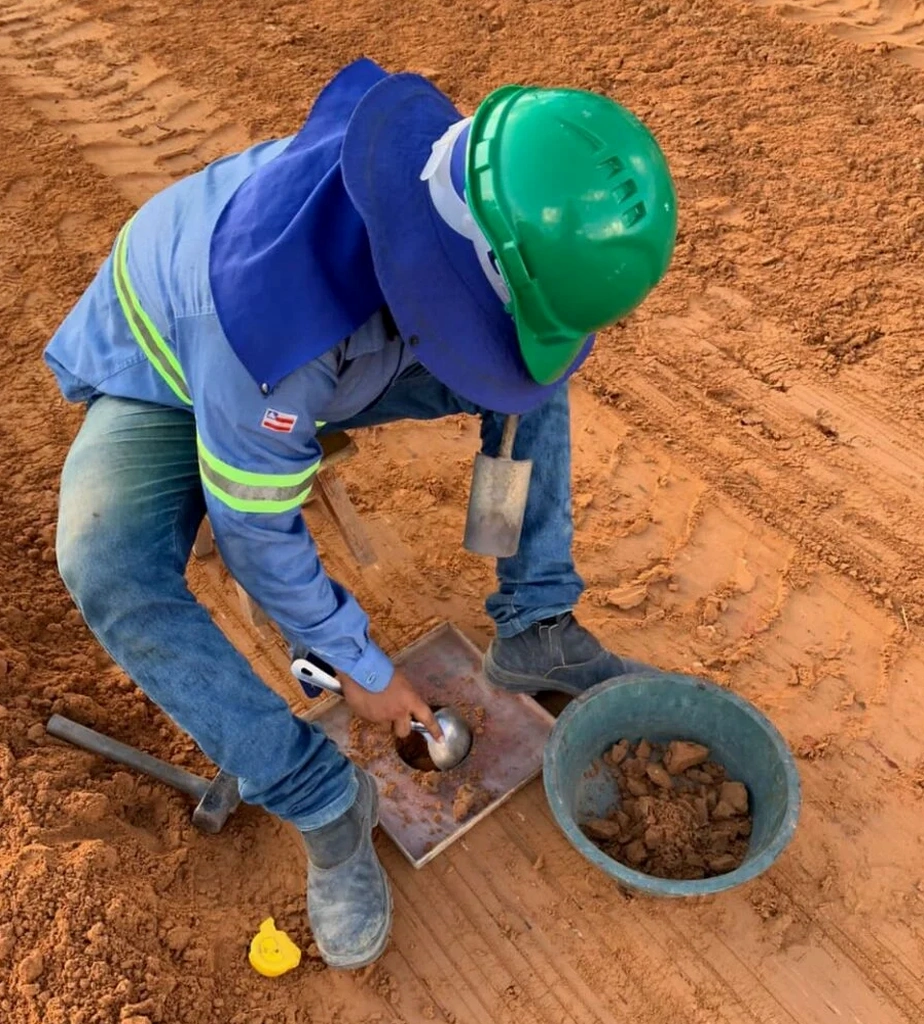
Escondido sits at roughly 684 feet above sea level, with summer temperatures that routinely exceed 90 degrees Fahrenheit — conditions that accelerate moisture loss in exposed subgrade and can throw off sand cone readings if the crew is not methodical. The ASTM D1556 procedure uses calibrated Ottawa sand, a density plate, and a field scale to measure the volume of a small test hole. From that volume and the moist weight of the excavated soil, we calculate wet density, then apply the moisture correction to obtain dry density. The number is compared against the laboratory maximum dry density from a modified or standard Proctor curve. Common test depths range from 4 to 8 inches, which captures typical lift thicknesses for structural fill and utility trench backfill. The method is not suitable for soils containing significant rock fragments larger than 1.5 inches — in those situations we document the oversize correction or shift to a nuclear gauge or CPT correlation if the spec allows it. Most Escondido projects require one test per 1,500 to 2,500 square feet of compacted area, with additional tests at trench zones and around retaining structures.
Field Density Testing (Sand Cone Method) in Escondido, CA
Technical reference — Escondido

Site-specific factors

The most common mistake we see on Escondido job sites is running density tests on fill that was compacted at the wrong moisture content — the numbers look acceptable on the gauge, but the soil loses strength after the first winter rains because the clay fraction swells and the density drops. Another recurring problem is testing only the center of a building pad while ignoring the edges, where compaction is harder to achieve with large rollers. Failed density tests trigger re-compaction, re-testing, and sometimes removal of an entire lift, which delays the slab pour and adds equipment costs. For hillside lots with engineered fill deeper than three feet, inadequate compaction can contribute to differential settlement that cracks floor slabs and pulls apart stucco within the first two years. The sand cone method, when executed by a technician who understands the local decomposed granite formations and the moisture sensitivity of Escondido's alluvial soils, catches these problems before they become structural liabilities.

Need a geotechnical assessment?

Reply within 24h.

Email: contact@geotechnicalengineering1.com

Applicable standards

ASTM D1556 - Standard Test Method for Density and Unit Weight of Soil in Place by Sand-Cone Method, ASTM D698 / D1557 - Standard Test Methods for Laboratory Compaction Characteristics, ASTM D2216 - Standard Test Methods for Laboratory Determination of Water (Moisture) Content, Caltrans Standard Specifications Section 19 (Earthwork), IBC Chapter 18 - Soils and Foundations

Technical parameters

ParameterTypical value
Standard methodASTM D1556 / AASHTO T 191
Test depth range4 to 8 inches typical
Calibration sandGraded Ottawa sand, bulk density certified
Applicable soil typesFine-grained, sand, gravel (max particle < 1.5 in)
Moisture contentField oven-dry or Speedy moisture tester
Compaction acceptance90% to 95% relative compaction per spec
Frequency (building pads)1 per 1,500–2,500 ft² per lift
Report turnaroundSame-day field report, final PDF within 24 h

Common questions

How much does a sand cone field density test cost in Escondido?
How many density tests does the city of Escondido require for a residential slab?

The city follows IBC and Caltrans guidelines — typically one test per 1,500 to 2,500 square feet per lift of compacted fill. For a standard 2,000-square-foot home pad with one or two lifts, expect at least two to four tests spread across the pad and any utility trench backfill that falls within the building footprint.

Can the sand cone method be used on crushed aggregate base for a driveway?

Yes, provided the maximum particle size does not exceed about 1.5 inches. The technician will dig the test hole carefully to minimize aggregate disturbance. For coarse base rock with larger fragments, we may recommend a nuclear gauge alternative or apply an oversize correction based on a grain-size analysis of the material.

How quickly do we get the density test report after the field work?

The technician provides a verbal pass-fail and the wet density reading on site immediately after each test. A formal PDF report with dry density, moisture content, and relative compaction percentage is delivered within 24 hours — same day if the schedule and lab oven availability permit.

Location and service area

We serve projects across Escondido and surrounding areas.

View larger map