GEOTECHNICALENGINEERING1
ESCONDIDO
HomeUnderground ExcavationsGeotechnical analysis for soft soil tunnels

Geotechnical Analysis for Soft Soil Tunnels in Escondido

Sound ground. Sound decisions.

LEARN MORE

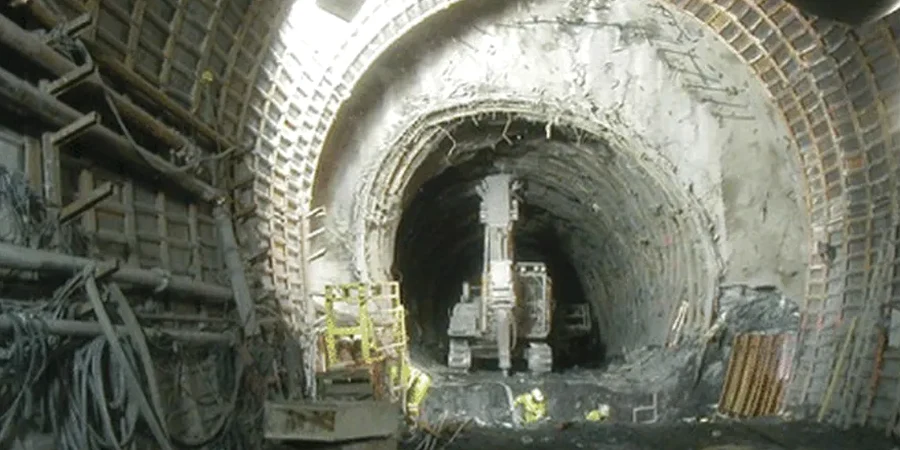
Escondido’s expansion eastward from the historic downtown core has placed new infrastructure demands on the alluvial fans and weathered granitic residuum that blanket the valley floor. As the city extends utility corridors and transportation links beneath Escondido Creek’s former floodplain, tunnel designers encounter a subsurface profile far removed from the competent rock assumed in standard highway manuals. The transition from decomposed granite to saturated silty sands across just a few hundred feet of alignment creates differential face conditions that demand a more rigorous characterization protocol. Our laboratory in Escondido applies a phased testing framework—combining disturbed and undisturbed sampling with advanced triaxial and consolidation programs—to model the time-dependent settlement and squeezing behavior that govern liner design in these soft ground environments. For alignments where alluvial pockets coincide with a seasonally high water table, the in-situ permeability testing program becomes essential to calibrate dewatering assumptions before TBM mobilization.

In Escondido’s alluvial corridors, the difference between a successful EPB drive and a stalled face often traces back to the quality of the consolidation and triaxial data collected months before mobilization.
Our service areas

Methodology and scope

The subsurface contrast between Escondido’s eastern mesa neighborhoods and the older central district illustrates the range of conditions a single tunnel drive can encounter. In the central area near Grape Day Park, alluvial deposits extend to depths exceeding forty feet, often with lenses of organic silt that exhibit pronounced creep under unloading. Out toward Kit Carson Park and the San Pasqual Valley edge, the overburden transitions to a stiffer residual soil derived from tonalite, where stand-up time improves but abrasivity increases significantly. A representative testing suite for these mixed-face conditions includes consolidated-undrained triaxial with pore pressure measurement to capture the undrained shear strength profile, one-dimensional consolidation to estimate long-term settlement, and particle size distribution per grain-size analysis to correlate abrasivity indices with cutter wear predictions. Each parameter feeds directly into the convergence-confinement analysis that determines temporary support requirements and influences the contractor’s excavation cycle planning. The characterization must also account for the cemented conglomerate lenses that appear unpredictably within the alluvium, which can mislead penetration-rate interpretations if not identified through continuous sampling or downhole geophysics.
Geotechnical Analysis for Soft Soil Tunnels in Escondido
Technical reference — Escondido

Site-specific factors

In Escondido, the most recurrent mechanism we observe during pre-construction investigations is the misinterpretation of cemented alluvial horizons as bedrock refusal. Drillers advancing hollow-stem augers through the central valley frequently encounter caliche-like layers at depths between eighteen and thirty feet, reporting premature refusal and truncating the borehole log above softer, more compressible strata below. When tunnel design proceeds on the assumption that competent material extends downward from that refusal depth, the as-built crown can end up seated within saturated, low-plasticity silts that ravel continuously and generate settlements far exceeding the empirical predictions. A second concern involves the seasonal groundwater oscillation beneath the Escondido Creek recharge zone: pore pressure profiles measured in September, after the dry summer drawdown, can differ by more than twelve feet from those obtained in March, altering the effective stress regime at the tunnel springline. Our protocol for Escondido projects mandates at least two pore-pressure measurement campaigns, offset by six months, supplemented by laboratory permeability on undisturbed Shelby tube samples to bracket the transient seepage forces that act on the face during EPB or open-shield operations.

Need a geotechnical assessment?

Reply within 24h.

Email: contact@geotechnicalengineering1.com

Applicable standards

ASTM D4767-11 – Consolidated Undrained Triaxial Compression Test for Cohesive Soils, ASTM D2435/D2435M-11 – One-Dimensional Consolidation Properties of Soils, ASTM D2487-17 – Classification of Soils for Engineering Purposes (USCS), IBC Chapter 18 – Soils and Foundations (with California amendments), ASCE/CI 38-02 – Standard Guideline for the Collection and Depiction of Existing Subsurface Utility Data

Technical parameters

ParameterTypical value
Undrained shear strength (su) range15–45 kPa (alluvium), 50–120 kPa (residuum)
Plasticity index (PI)8–22 (alluvial silts), NP–12 (weathered granite)
Permeability coefficient (k)1×10⁻⁵ to 5×10⁻³ cm/s (field variable-head)
Consolidation stress historyOCR 1.2–2.8 in upper alluvium, ~1.0 below 25 ft
Abrasivity (NTNU/SAT)SAT 2–18, dependent on quartz content in residuum
Face stability ratio (N)1.8–4.2 under groundwater, EPB conditioning required
Applicable ASTM standardsD4767, D2435, D2487, D5084, D6913

Common questions

What is the typical cost for a soft soil tunnel geotechnical analysis in Escondido?
Which laboratory tests are most critical for soft ground tunnel design in Escondido’s alluvial soils?

Consolidated-undrained triaxial tests (ASTM D4767) with pore pressure measurement are essential to define the undrained shear strength profile. One-dimensional consolidation (ASTM D2435) provides the compression index and preconsolidation pressure needed to estimate long-term settlement and face squeezing potential. These are complemented by grain-size analysis and Atterberg limits to classify the soil within the USCS framework and correlate with published case histories.

How long does a tunnel geotechnical investigation take from mobilization to final report?

A typical program for a short to medium-length tunnel alignment in Escondido requires four to six weeks for drilling and in-situ testing, plus an additional three to five weeks for laboratory testing and engineering analysis. If the scope includes seasonal groundwater monitoring, the field phase extends to capture at least two hydrogeological cycles, adding approximately six months to the overall schedule but substantially reducing the risk of encountering unanticipated face pressures during excavation.

Location and service area

We serve projects across Escondido and surrounding areas.

View larger map