GEOTECHNICALENGINEERING1
ESCONDIDO
HomeInvestigationSPT (Standard Penetration Test)

Standard Penetration Test (SPT) in Escondido, CA — Site Investigation You Can Count On

Sound ground. Sound decisions.

LEARN MORE

The soils beneath Valley Center Road tell a different story than those near Kit Carson Park. One site is perched on weathered granitic bedrock. The other sits on younger alluvial sediments from Escondido Creek. The difference in foundation design between the two? Massive. In Escondido, where decomposed granite can fool even experienced contractors into thinking they have stable ground, the Standard Penetration Test is the only reliable way to quantify what you're building on. Our SPT drilling delivers N-values, sample recovery data, and soil classification per ASTM D1586, giving your structural engineer the numbers they need to size footings correctly. We have worked on sites from the Rincon Del Diablo area to the industrial corridor near the I-15, and the subsurface variability always surprises those who skip proper grain-size analysis after their borings.

Decomposed granite in Escondido can look like rock but behave like soil. SPT blow counts are the only way to tell the difference before excavation begins.
Our service areas

Methodology and scope

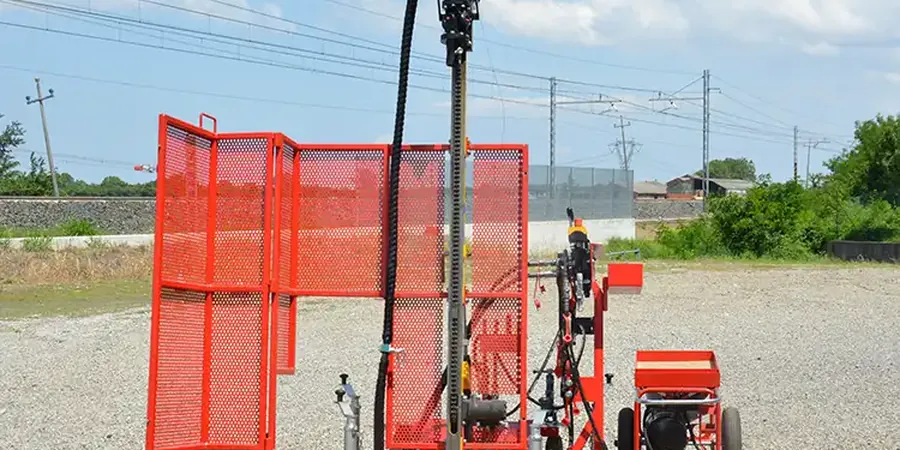
The single biggest mistake we see in North County is assuming decomposed granite is bedrock. It isn't. It behaves like a dense sandy silt when saturated and can lose significant strength after a few rainy seasons. A proper SPT boring distinguishes between weathered rock and true competent granite before the concrete is poured. Our rigs can access tight lots in downtown Escondido and larger properties in the San Pasqual Valley without issue. Each SPT run records blow counts at 6-inch intervals, and we log the soil type using ASTM D2487 visual-manual classification right at the borehole. For sites where fill material is suspected, combining SPT with a triaxial test on undisturbed Shelby tube samples gives you both strength parameters and a clear picture of settlement potential. The City of Escondido Building Department reviews these reports closely, and incomplete soil data is the most common reason for plan check corrections we see.
Standard Penetration Test (SPT) in Escondido, CA — Site Investigation You Can Count On
Technical reference — Escondido

Site-specific factors

Escondido sits in a unique microclimate, just far enough inland to avoid the marine layer but close enough to feel its influence on shallow groundwater. The difference between east Escondido and the areas near Lake Hodges in terms of subsurface moisture can be dramatic. A boring drilled in September might hit groundwater at 40 feet. The same boring in March could encounter water at 15 feet. This seasonal swing affects SPT N-values in saturated silts and fine sands, and ignoring it leads to unconservative bearing capacity assumptions. The City of Escondido is also in Seismic Design Category D, and the 2015 Uniform California Earthquake Rupture Forecast (UCERF3) places the Rose Canyon and Elsinore fault systems within regional influence. Soft alluvial soils can amplify ground motion, and SPT data feeds directly into site class determination under ASCE 7-22 Chapter 20, which governs the seismic coefficient used in your structural design.

Need a geotechnical assessment?

Reply within 24h.

Email: contact@geotechnicalengineering1.com

Explanatory video

Applicable standards

ASTM D1586-18 — Standard Test Method for Standard Penetration Test (SPT) and Split-Barrel Sampling of Soils, ASTM D2487-17 — Standard Practice for Classification of Soils for Engineering Purposes (Unified Soil Classification System), ASCE 7-22 — Minimum Design Loads and Associated Criteria for Buildings and Other Structures, Chapter 20, IBC 2021 — International Building Code, Section 1803 Geotechnical Investigations

Technical parameters

ParameterTypical value
Test StandardASTM D1586-18
Borehole Diameter4 to 8 inches
Hammer TypeSafety hammer, 140 lb, 30-inch drop
Sampling IntervalContinuous or every 5 feet
Typical Depth Range in Escondido15 to 60 feet
N-value CorrectionN60 per Seed & Idriss method
ReportingLogs with N-values, soil description, groundwater

Common questions

What does an SPT investigation cost in Escondido?
How deep do you drill for SPT in Escondido?

Most residential jobs go to 25 or 30 feet, enough to penetrate the weathered granite layer and confirm competent bearing material. For multi-story structures or sites near the creek corridors, 40 to 60 feet is common. We follow the IBC requirement of investigating to a depth where the stress increase from the foundation is less than 10% of the existing overburden pressure.

How long until I get the SPT report?

Drilling and field logging are completed in one day for most standard projects. The lab data, if required, adds 5 to 7 business days. We email the signed PDF report with boring logs, N-values, and engineering recommendations within 10 business days of fieldwork.

Does the Escondido Building Department require SPT for ADU permits?

Yes. The City of Escondido requires a soils report with borings for new detached ADUs per the 2022 California Residential Code R401. We have submitted dozens of SPT reports for ADU projects in Escondido and can coordinate directly with your architect or permit expediter to avoid plan check delays.

Location and service area

We serve projects across Escondido and surrounding areas.

View larger map