GEOTECHNICALENGINEERING1
ESCONDIDO
HomeSlopes & WallsRetaining wall design

Retaining Wall Design in Escondido: Engineered Earth Retention for Coastal Valley Terrain

Sound ground. Sound decisions.

LEARN MORE

The granitic foothills around Escondido present a constant challenge for builders. Decomposed granite here can stand vertically when dry but slumps rapidly with the first winter storm. We design retaining walls that account for this behavior. A wall in Escondido must handle more than just static earth pressure. The city's position 18 miles inland from the Pacific means morning marine layer humidity saturates the upper soil, while afternoon Santa Ana winds dry it to dust. This wet-dry cycling expands and contracts clay seams within the decomposed granite, creating lateral pressures that standard designs don't address. Our approach starts with site-specific soil data. Before finalizing any wall geometry, we often run a grain-size analysis to quantify fines content and correlate it with the expansive potential of the weathered rock.

A properly designed wall in Escondido's decomposed granite should last 75 years. The difference between a 15-year wall and a 75-year wall is always in the drainage detail.
Our service areas

Methodology and scope

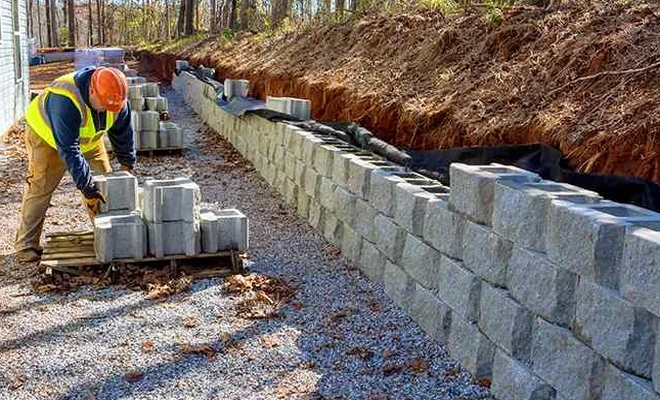
Escondido's development followed the valley floors first, then pushed into the hillsides during the post-war boom. Many of those original 1950s-era cut slopes are now reaching the end of their natural stability cycle. We see this in neighborhoods like Kit Carson and East Canyon, where older properties abut newer construction on higher pads. A retaining wall here serves two masters: the developer's budget and the geotechnical reality of colluvium over granodiorite. We size stem walls, cantilever walls, and gravity walls based on the retained height and the surcharge from adjacent structures. For cuts exceeding 12 feet, the design must account for potential sliding along relict joint planes in the bedrock. The CPT test gives us a continuous profile of tip resistance and sleeve friction, which is particularly useful when the granite weathering profile varies sharply across a single lot. We input these parameters directly into our limit equilibrium models.
Retaining Wall Design in Escondido: Engineered Earth Retention for Coastal Valley Terrain
Technical reference — Escondido

Local considerations

A 9-foot-tall segmental block wall on a sloped lot near Dixon Lake failed three years after construction. The owner had skipped the geotechnical investigation. The wall leaned 4 inches out of plumb and the upper course blocks had cracked. What went wrong? The designer assumed a clean sand backfill, but the native soil was silty sand with a trace of clay. Water built up behind the wall during a wet January. Hydrostatic pressure added 30% more lateral load than the wall could resist. The repair cost exceeded the original construction budget. In Escondido, where winter rainfall can arrive in three concentrated atmospheric river events, drainage design is not an accessory. It is the primary defense. We specify a continuous drainage blanket behind every wall, not just a weep hole every 6 feet.

Need a geotechnical assessment?

Reply within 24h.

Email: contact@geotechnicalengineering1.com

Applicable standards

IBC 2021 Chapter 18 – Soils and Foundations, ASCE 7-22 – Minimum Design Loads for Buildings and Other Structures, ASTM D2487 – Unified Soil Classification System, AASHTO LRFD Bridge Design Specifications (for tiered wall systems)

Technical parameters

ParameterTypical value
Design StandardIBC 2021 Chapter 18 / ASCE 7-22
Typical Retained Height Range1.2 m to 8.5 m (4 ft to 28 ft)
Backfill MaterialFree-draining crushed rock, 3/4-inch minus, compacted to 95% relative density
Drainage SystemPerforated 4-inch HDPE pipe at base, wrapped in filter fabric, daylighted every 15 m
Bearing Capacity VerificationMinimum 150 kPa (3,000 psf) allowable for strip footings on dense decomposed granite
Seismic Coefficient (kh)0.15 to 0.22 per ASCE 7 site class C/D
Expansive Clay MitigationRemove and replace 60 cm below footing if PI exceeds 25%

Frequently asked questions

Do I need a permit for a retaining wall in Escondido?

Yes. The City of Escondido requires a building permit for any retaining wall over 3 feet in height, measured from the bottom of the footing to the top of the wall. Walls supporting a surcharge, such as a driveway or pool, require engineered calculations and a soils report regardless of height.

What is the cost range for retaining wall design in Escondido?

Design fees typically range from US$1,150 to US$4,010 depending on wall height, complexity, and whether the project requires a global slope stability analysis. A simple 4-foot garden wall with no surcharge is at the lower end; a 20-foot tiered wall system with multiple terraces and drainage integration is at the upper end.

How long does the design process take?

A standard retaining wall design package takes 10 to 15 business days after we receive the soils report and site survey. Projects requiring slope stability modeling or coordination with the structural engineer may extend to 3 weeks.

What soil information do you need before starting the design?

We need a geotechnical investigation with borings or test pits within the wall footprint, laboratory classification of the retained soil and foundation bearing stratum, and groundwater level observation. If expansive soils are present, we need Atterberg limits and expansion index data.

Can you design a wall on a property line?

Yes, but it requires careful coordination. Property line walls in Escondido must satisfy both the Building Code and any private easement or covenant restrictions. We design the footing so no portion encroaches onto the adjacent property, and we specify a construction sequence that protects the neighbor's grade during excavation.

Location and service area

We serve projects across Escondido and surrounding areas.

View larger map