GEOTECHNICALENGINEERING1
ESCONDIDO
HomeSlopes & WallsSlope stability analysis

Slope Stability Analysis in Escondido CA — Hillside Geotechnical Reports

Sound ground. Sound decisions.

LEARN MORE

The drilling rig positioned on an Escondido slope is typically a compact track-mounted unit, chosen specifically to navigate the granite boulders and weathered tonalite that dominate the foothills south of Dixon Lake. Before a single Shelby tube is driven, the crew assesses access angles because many lots in this city, particularly those east of the I-15, sit on gradients exceeding 20 percent. Samples extracted from these boreholes are taken to a laboratory accredited under ASTM D3740 protocols, where they undergo direct shear and triaxial compression to determine the friction angle of the decomposed rock. The entire exercise answers one critical question: will this hillside remain stable after a winter storm drops two inches of rain on already saturated colluvium?

A slope failure in Escondido's decomposed granite is rarely a sudden collapse; it is a progressive creep triggered by irrigation mismanagement and poor surface drainage, which a proper analysis can intercept early.
Our service areas

Methodology and scope

Escondido sits at an average elevation of 684 feet, but the micro-topography varies dramatically between the flat alluvial plain near the city center and the steep volcanic ridges around Lake Hodges. This contrast means that a single slope stability model cannot serve the entire municipality. Where the terrain is underlain by Santiago Peak metavolcanics, the rock mass can hold a near-vertical cut for decades, yet the same slope orientation in the soft sedimentary layers of the San Marcos Formation requires benching and a designed setback. Our approach integrates a cone penetration test to map the depth to bedrock without disturbing the sample structure, paired with a seismic refraction survey that reveals the rippability of the subsurface before grading begins, ensuring the earthwork specifications match the actual site conditions rather than a generic county assumption.
Slope Stability Analysis in Escondido CA — Hillside Geotechnical Reports
Technical reference — Escondido

Local considerations

The geotechnical risk profile of a property in the Harmony Grove area, with its deep alluvial terraces and historical agricultural grading, differs fundamentally from a lot carved into the granitic boulder fields of the Rancho San Pasqual valley. On the western flank of the city, expansive clay layers can lose cohesion with a mere three-percent increase in moisture content, while the eastern slopes face block toppling hazards if the joint sets in the bedrock dip unfavorably toward a planned excavation. When these conditions overlap with a mapped fault zone, the analysis must incorporate the pseudostatic coefficient derived from the Elsinore and San Jacinto fault systems. For projects requiring deep cuts adjacent to existing structures, we often recommend combining the slope model with a retaining wall design that uses drilled soldier beams to create a redundant lateral support system.

Need a geotechnical assessment?

Reply within 24h.

Email: contact@geotechnicalengineering1.com

Applicable standards

ASCE/SEI 7-22 (Minimum Design Loads and Associated Criteria for Buildings and Other Structures), IBC 2024 Chapter 18 (Soils and Foundations) with California amendments, ASTM D1586-18 (Standard Test Method for Standard Penetration Test), ASTM D2487-17 (Classification of Soils for Engineering Purposes — Unified Soil Classification System), FHWA-NHI-05-094 (Soil Slope and Landslide Stabilization Design)

Technical parameters

ParameterTypical value
Minimum design factor of safety (static)1.5
Minimum design factor of safety (pseudostatic)1.1
Target peak ground acceleration (PGA)0.45g (per ASCE 7-16 site class D)
Soil shear strength testing methodASTM D3080 (direct shear), ASTM D4767 (triaxial)
Typical slope angle requiring engineered mitigation> 2H:1V (26.6 degrees) in cut scenarios
Groundwater monitoring durationMinimum one wet season (November–April)
Common failure mode analyzedTranslational sliding along colluvium-bedrock interface

Frequently asked questions

When does the City of Escondido require a slope stability analysis for a building permit?

The Escondido Building Division typically triggers a review when a proposed structure sits within 50 horizontal feet of a slope steeper than 3H:1V, or when the slope itself exceeds 15 feet in height measured vertically. The requirement is based on IBC Chapter 18 and the California Building Code, which mandate a geotechnical report addressing global stability and surcharge loading for any development in a hillside zone.

What distinguishes a static analysis from a pseudostatic analysis for an Escondido slope?

A static analysis evaluates the slope under normal gravity and water conditions, targeting a factor of safety of 1.5. A pseudostatic analysis adds a horizontal seismic coefficient (typically 0.15 to 0.22 for Escondido's site class) to simulate the inertial forces during an earthquake on the Elsinore fault. The pseudostatic factor of safety must exceed 1.1 for the slope to be considered stable under seismic loading per ASCE 7-22 criteria.

How much does a slope stability analysis cost in Escondido?

The cost ranges from US$1,220 for a desktop-level review of an existing lot with available historical data, up to US$4,210 for a full investigation that includes a drilling program, laboratory shear testing, piezometer installation, and a stamped report with cross-sections ready for city submittal. The final figure depends on slope height, access difficulty, and the number of cross-sections required.

Can an existing slope that has moved be stabilized without rebuilding the entire hillside?

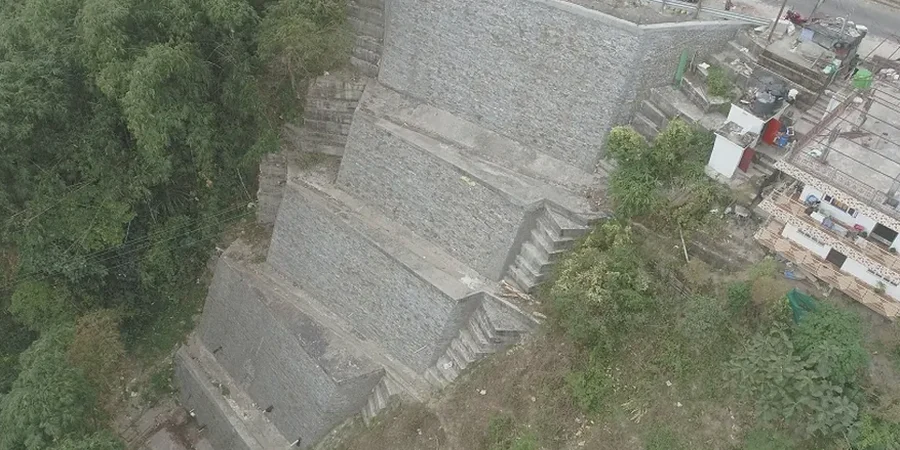
Yes, in many cases. Depending on the failure depth mapped during the investigation, solutions range from subsurface drainage systems that lower the groundwater table to soil nail walls or anchored mesh systems. The key is identifying the failure plane through inclinometer readings and then designing a structural element that extends past that plane into stable material.

What laboratory tests are essential for a reliable stability analysis in decomposed granite?

At minimum, we run a direct shear test (ASTM D3080) on a remolded sample compacted to field density to determine the drained friction angle. For slopes with a critical height or where silt content is high, we add a consolidated-undrained triaxial test (ASTM D4767) with pore pressure measurements. Atterberg limits and gradation testing provide the classification context required by ASTM D2487.

Location and service area

We serve projects across Escondido and surrounding areas.

View larger map