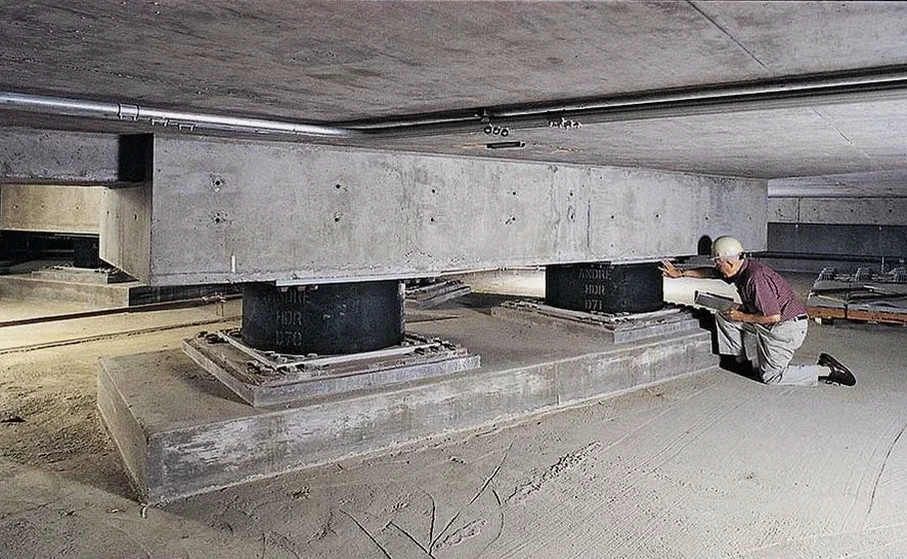
ASCE 7-22 and the California Building Code make base isolation an increasingly common strategy for critical facilities in Southern California, and Escondido is no exception. The city sits roughly 15 miles inland from the Pacific coast, where the Rose Canyon and Elsinore fault systems shape the seismic hazard profile. Our laboratory handles the soil and material characterization that feeds directly into isolator design: dynamic properties of the foundation soils, cyclic behavior of the bearing materials, and the interface friction parameters that govern displacement capacity. Without this data, the isolation system is just an assumption. We run the triaxial tests that give you the modulus degradation curves needed for nonlinear time-history analysis, and we pair them with site-specific MASW surveys to confirm the Vs profile at the isolation plane.
An isolation system is only as predictable as the soil it rests on: if the bearing stratum stiffness is off by 20%, the isolator displacement doubles