GEOTECHNICALENGINEERING1
ESCONDIDO
HomeInvestigationCPT (Cone Penetration Test)

CPT Testing in Escondido: Accurate Soil Stratigraphy and Geotechnical Parameters

Sound ground. Sound decisions.

LEARN MORE

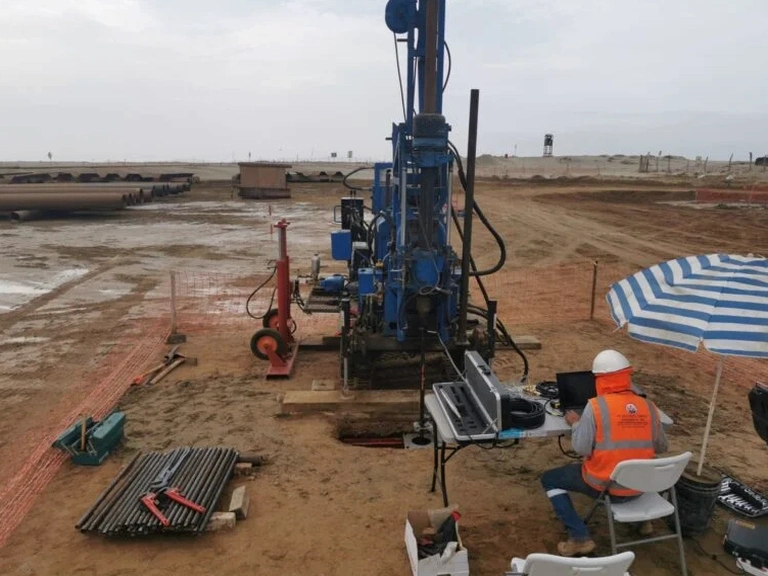
A recent infill project on Valley Parkway hit buried fill at 14 feet. The logs from nearby borings showed competent alluvium. The contractor had already poured footings when the discrepancy surfaced. Our CPT rig completed a sounding in 45 minutes. The data showed a clear drop in tip resistance and spike in friction ratio at that depth. No auger cuttings to misclassify. No sample disturbance to hide the soft layer. We see this mismatch frequently across Escondido neighborhoods where historical agricultural grading or undocumented fills overwrite the natural Pleistocene terrace deposits. A reliable CPT test eliminates the guesswork by delivering continuous digital logs with depth resolution under 2 centimeters. In Escondido's mix of granitic residuum and alluvial channels, that resolution matters. The cone detects thin seams of silt or clay that a standard SPT spoon can miss entirely, especially when combined with soil classification via grain-size analysis to calibrate the friction ratio readings against laboratory-measured fines content.

A CPT sounding in Escondido alluvium captures the exact depth to competent bearing stratum within 2 cm resolution. No other in-situ test delivers that precision at this speed.
Our service areas

Methodology and scope

The subsurface contrast between Escondido's eastern hills and the downtown basin is striking. Up near Dixon Lake, decomposed granite dominates the profile. Tip resistance often exceeds 150 tsf within 8 feet. Pore pressure dissipation is fast. Settlement under load is minimal. Down along Escondido Creek, the story changes. Soft alluvium with organics extends to 25 feet. CPT soundings here register tip resistance below 10 tsf and friction ratios above 4 percent. These numbers demand a different foundation strategy. The cone data feeds directly into bearing capacity models and allows us to optimize shallow footing design for the stiffer upland sites while flagging the need for deeper support in the basin. In transition zones we frequently run a complementary SPT drilling program to recover disturbed samples for visual classification and laboratory index testing. The CPT provides the continuous profile. The SPT provides the physical sample. Together they give Escondido engineers a defensible basis for foundation recommendations under ASCE 7-22 Chapter 20.
CPT Testing in Escondido: Accurate Soil Stratigraphy and Geotechnical Parameters
Technical reference — Escondido

Local considerations

Escondido sits within Seismic Design Category D per ASCE 7. The alluvial deposits along Escondido Creek and in parts of the city's western basin have groundwater within 15 feet of surface during wet years. These saturated granular soils warrant a liquefaction screening on any project with a building permit trigger. CPT data is the preferred input for the NCEER-Youd-Idriss simplified procedure and the more recent Boulanger-Idriss update. The continuous sleeve friction and tip resistance let us calculate the factor of safety against liquefaction at every depth increment. A boring log with SPT blow counts every 5 feet cannot match that resolution. We run the numbers against the M7.8 Rose Canyon or M7.5 Elsinore scenario. The output dictates whether ground improvement is needed. In some Escondido zones we have measured cyclic resistance ratios below 0.09 in the upper 20 feet. That triggers a liquefaction mitigation study and often leads to densification via vibrocompaction or stone column installation before foundation construction begins.

Need a geotechnical assessment?

Reply within 24h.

Email: contact@geotechnicalengineering1.com

Applicable standards

ASTM D5778-20 Standard Test Method for Electronic Friction Cone and Piezocone Penetration Testing of Soils, ASCE 7-22 Chapter 20 Site Classification Procedure using CPT data, IBC 2024 Chapter 18 Soils and Foundations, Robertson & Wride (1998) CPT-based liquefaction triggering procedure, Boulanger & Idriss (2014) CPT and SPT liquefaction triggering correlations

Technical parameters

ParameterTypical value
Cone tip resistance (qc)0 to 200 tsf typical for Escondido soils
Sleeve friction (fs)0.05 to 8 tsf depending on fines content
Friction ratio (Rf)0.2% in clean sands; 3 to 8% in clays
Pore pressure (u2)Measured at shoulder; hydrostatic to 60 psi
Equivalent SPT N60Derived via qc/N60 correlation per Robertson
Soil behavior type (SBT)Per Robertson 1990 and updated 2016 charts
Sounding depth capacityUp to 65 feet in Escondido formations
Data interval10 to 50 mm continuous digital recording

Frequently asked questions

What depth can a CPT rig reach in Escondido's decomposed granite?

In typical Escondido decomposed granite formations near Dixon Lake and the eastern hills, our 20-ton CPT truck can push to refusal, which usually occurs between 30 and 55 feet depth when tip resistance exceeds 180 to 200 tsf. In the softer alluvium of the Escondido Creek basin, we routinely reach 60 to 65 feet without refusal. The actual refusal depth depends on weathering grade and the presence of corestones. We monitor push force and inclination continuously to stop before equipment damage if a hard obstruction is encountered.

How much does a CPT sounding cost in Escondido?

A standard CPT sounding in Escondido ranges from US$190 to US$280 per test location, depending on total depth, traffic control requirements, and whether piezocone or seismic cone modules are needed. Mobilization is a separate line item. For projects requiring multiple soundings, per-unit cost decreases. We provide a fixed-price proposal after reviewing the site address and approximate target depths.

Can CPT replace soil borings for an Escondido building permit?

CPT provides continuous stratigraphy and engineering parameters but does not recover physical soil samples. The City of Escondido Building Division and most geotechnical reviewers accept CPT as a primary investigation method when paired with at least one calibration boring or test pit to confirm soil classification and collect samples for laboratory index testing. We recommend running a single SPT boring to correlate with the CPT soundings, especially in areas with variable fill history like central Escondido.

How quickly can CPT results be delivered for an Escondido project?

Field data is available immediately after each sounding as raw digital logs. Interpreted engineering parameters, soil behavior type classification, and liquefaction analysis are typically delivered within 48 to 72 hours of completing field work. For urgent projects where foundation decisions are pending, we can provide a preliminary verbal summary with key bearing depths and liquefaction screening results on the same day as the sounding.

Location and service area

We serve projects across Escondido and surrounding areas.

View larger map