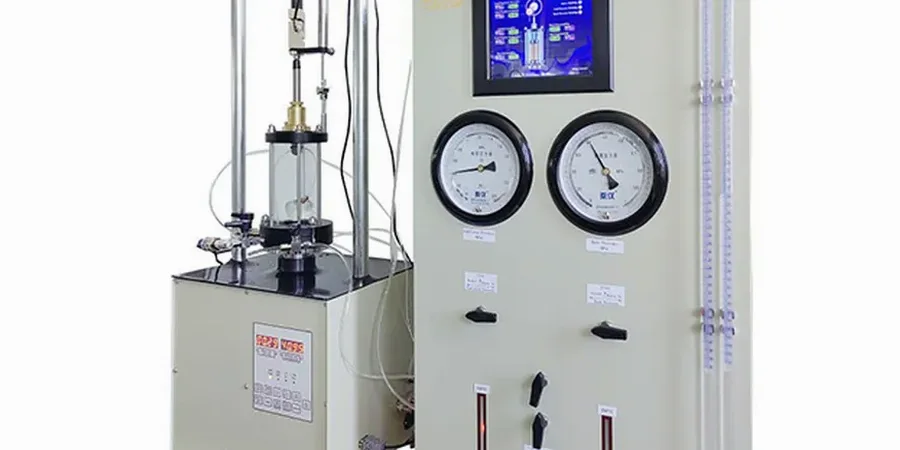
The triaxial cell on our load frame pressurizes a soil specimen inside a transparent chamber while a piston applies controlled axial deformation. In our Escondido lab we run two main protocols: consolidated undrained (CU) with pore pressure measurement for short-term loading scenarios, and consolidated drained (CD) when the designer needs effective stress parameters for long-term stability. A typical Escondido silty sand, sampled from decomposed granite residuum common in the hills east of I-15, reaches peak deviator stress between 80 and 220 kPa depending on confinement, and the pore pressure transducer captures the exact moment the skeleton starts yielding. When the project involves deep excavations in cemented terrace deposits, we often pair triaxial data with a CPT campaign to map the stratigraphy continuously before selecting undisturbed samples for the cell.
A triaxial test does not give you a single number; it gives you a failure envelope that separates safe from unsafe in the Mohr-Coulomb space.