GEOTECHNICALENGINEERING1
ESCONDIDO
HomeInvestigationExploratory test pit

Exploratory Test Pit Services in Escondido – Subsurface Verification

Sound ground. Sound decisions.

LEARN MORE

Escondido sits on a complex interface between granitic bedrock and alluvial deposits, with decomposed granite covering much of the northern valley floor. Depth to competent rock rarely exceeds 15 feet in hillside subdivisions, but groundwater can appear seasonally in the lower Escondido Creek drainage. An exploratory test pit lets you see these transitions directly. We open trenches up to 14 feet deep, log strata per ASTM D2487, and photograph every wall before backfilling starts. For projects near the Rincon del Diablo formation, we often pair the excavation with grain-size analysis to confirm the percentage of fines in weathered granite that standard borings might miss. The method is fast: most residential pits are completed, logged, and closed within a single working day.

A 10-foot test pit reveals more about soil structure than 30 feet of SPT split-spoon samples in the decomposed granite terrain of North County.
Our service areas

Methodology and scope

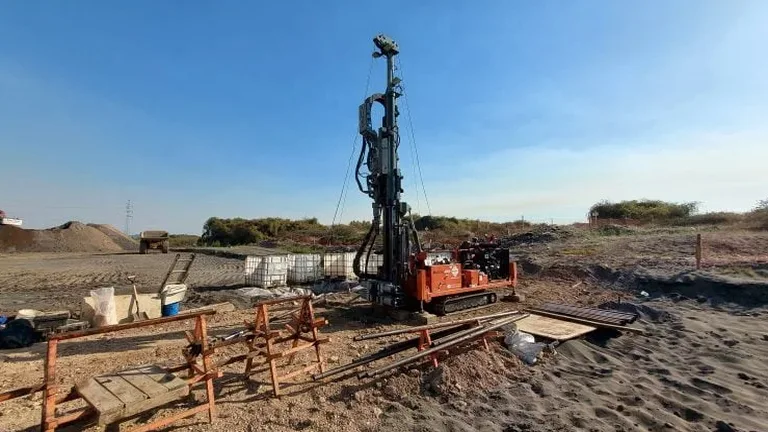
IBC Section 1803 requires soil classification and bearing verification prior to footing design. In Escondido, where decomposed granite can behave as either cohesionless or cohesive depending on weathering degree, ASTM D2487 visual-manual logging must be supplemented with lab index tests. We extract representative disturbed samples from each soil horizon encountered in the pit. These go to our AASHTO-accredited lab for moisture content, Atterberg limits, and gradation determination. The result is a defensible soil profile that satisfies City of Escondido plan-check requirements. For deeper bearing evaluation below the pit bottom, we recommend a complementary SPT drilling program to reach the refusal layer and rule out undocumented fill pockets. Every test pit report includes GPS-referenced location data, scaled wall sketches, and color photographs keyed to the log depths.
Exploratory Test Pit Services in Escondido – Subsurface Verification
Technical reference — Escondido

Local considerations

We routinely see contractors in Escondido treat decomposed granite as uniform material. It is not. Weathering intensity can shift from hard rock to sandy silt within three vertical feet, especially along the hillside margins where the granodiorite contact dips sharply. An exploratory test pit exposes these transitions before the excavator operator discovers them during footing excavation, which is always more expensive to fix after rebar is placed. Another common issue is undocumented fill: older residential lots near downtown Escondido often contain buried debris from 1950s construction that never appeared on grading plans. A single pit placed at the deepest proposed cut can save weeks of delay and a structural redesign. CAL-OSHA classification of the excavation as Type B or C soil also governs shoring requirements; the pit log provides that classification directly.

Need a geotechnical assessment?

Reply within 24h.

Email: contact@geotechnicalengineering1.com

Explanatory video

Applicable standards

ASTM D2487-17: Standard Practice for Classification of Soils for Engineering Purposes (Unified Soil Classification System), ASTM D2488-17: Standard Practice for Description and Identification of Soils (Visual-Manual Procedure), IBC 2021 Section 1803: Geotechnical Investigations, CAL-OSHA Title 8 Section 1541: Excavation, Trenching, and Shoring

Technical parameters

ParameterTypical value
Maximum excavation depth14 ft with shoring; 4 ft unshored per OSHA Subpart P
Standard bucket width24 in (hydraulic excavator)
Logging standardASTM D2487 / D2488 visual-manual classification
Sample collectionDisturbed bag samples per horizon; Shelby tubes for soft clay lenses
Groundwater documentationSeepage depth, rate, and stabilization time recorded
Typical liability coverageUSD 2 million general aggregate; CAL-OSHA excavation permit
Report turnaround48 hours for residential; 72 hours with laboratory index tests

Frequently asked questions

How deep can a test pit go in Escondido without engineered shoring?

OSHA Subpart P allows 4 feet for Type C soil without any protective system. For deeper pits, we install hydraulic trench boxes or cut the walls back to a 1.5:1 slope. Our standard pit depth is 10 to 12 feet, and we handle the shoring design in-house for depths up to 14 feet.

Does the City of Escondido accept test pit logs instead of boring logs for foundation design?

Yes, for shallow foundations on level terrain, the city building department accepts test pit logs provided they comply with IBC Section 1803 and include ASTM D2487 classification. Deeper foundations or sites with slope stability concerns will require supplemental borings.

What does an exploratory test pit cost in Escondido?

For a standard single pit up to 10 feet deep with logging and a typed report, the cost ranges from US$430 to US$880 depending on access, soil disposal requirements, and whether laboratory index testing is included.

How long does the excavation stay open, and is it safe for our crew?

We keep the pit open for approximately two to three hours for logging and photography, then backfill immediately. The site is fenced with high-visibility barriers during that window, and our field technician remains on site until the excavation is closed.

Can you identify undocumented fill from a test pit?

Yes, this is one of the main advantages. Debris, organic layers, abrupt color changes, and non-native material are visible on the pit wall. We flag these zones in the log and photograph them for the report, which gives the structural engineer documentation to adjust the foundation depth.

Location and service area

We serve projects across Escondido and surrounding areas.

View larger map